
Introduction
Understanding fundamental concepts such as justice, rights, law, dignity, morality, and peace is essential for building an effective intellectual and practical framework. This article places special emphasis on their practical relevance in everyday human life, because without clarity about these core concepts, humanity is doomed to wrestle with endless crises.
True philosophy, with a scientific and empirical approach, offers clear and examinable definitions for such concepts. In contrast, academic philosophy, by insisting on abstract and often obscure methods, has failed to provide clear and comprehensible definitions. This article seeks to explore the differing roles that conceptual definitions play in these two philosophical systems.
1. Conceptual Experience in True Philosophy
True philosophy relies on the observation of the living world. The study of living organisms—especially the human body—shows that concepts such as order and balance are not abstract, but experiential. The human body maintains order by ensuring that each part finds its proper place based on its abilities and responsibilities, and it preserves balance by distributing energy and resources in proportion to the needs of each part. This living model of an intelligent system serves as a foundation from which one can derive definitions of morality, justice, dignity, and law.
2. Concepts as Gateways to Understanding
In true philosophy, each concept—such as “Right” or “Justice”—is first introduced through a simple and clear definition, which then allows for further development of understanding. Each concise definition acts like a door handle, enabling access to a vast space of meaning. For instance, starting from the definition of health as “maintaining order and balance in the body and mind through prevention,” one can arrive at a definition of peace, which reinterprets the same principles of order and balance on the level of the human family.
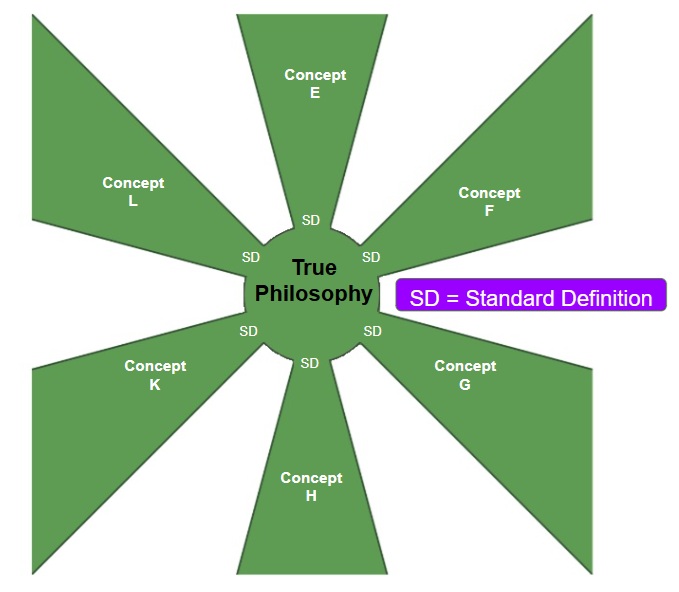
In True Philosophy, each fundamental concept begins with a Standard Definition (SD). This definition acts as a handle that opens the door to meaning and allows for an endless expansion of understanding. Together, these definitions form a coherent network of foundational concepts within True Philosophy—concepts that are logically interconnected and rooted in human lived experience and the structure of the human body.
3. Academic Philosophy: A Blockage to Meaning
In academic philosophy, fundamental concepts are often met with ambiguous, contradictory, or merely historical definitions. Key ideas such as justice, dignity, or law not only lack a unified definition, but attempts to define them often lead to endless debates. In this context, one unknown is described using another, and the chain of reasoning, rather than resolving problems, deepens the confusion.
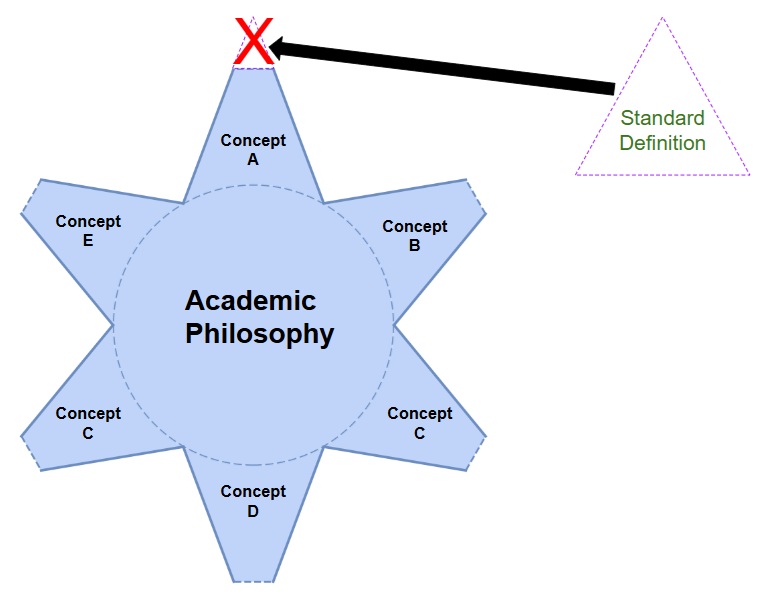
In academic philosophy, meaning is lost. Attempts to define concepts either reach a dead end or spiral into endless disputes. For example, the book What Is Philosophy? by Heidegger draws the curious reader in, hoping to uncover what philosophy truly is, yet in the end, it fails to provide a clear answer.
4. True Philosophy and the Scientific Method
True philosophy is grounded in the scientific method. Just as Einstein resolved the problem of Mercury’s orbit by moving beyond the Newtonian framework and proposing the theory of relativity, true philosophy also abandons traditional academic structures and derives its concepts from the fabric of existence itself—not from linguistic games or metaphysical abstractions. “Right”, understood as an intelligent energy forming living organisms, not only deepens our understanding of life but also lays the foundation for comprehending morality, law, and justice.
5. “Order and Balance,” the Basis for Discovering Abstract Concepts:
Examining order and balance in the human body provides an entry point into abstract concepts. In a living system, order means that each part finds its appropriate place based on its capacity, and balance refers to the fair distribution of energy needed for each part to fulfil its function. When this functional model is extended to the human community, it leads to key concepts such as dignity, morality, justice, and law.
6. Why Does True Philosophy Define Concepts?
Because in order to move from the realm of the unknown to the realm of the known, one must begin with at least one reliable “known.” The human body, by offering a living experience of order and balance, provides this initial known. From this foundation, one can reach broader and more abstract concepts such as peace, justice, and law. In contrast, academic philosophy, lacking an experiential anchor, remains adrift in the world of words.
Conclusion:
True philosophy, by providing clear definitions of fundamental concepts, paves the way for constructive dialogue, social reform, and individual development. In contrast, academic philosophy, by avoiding the definition of key terms, knowingly or unknowingly leaves the field open to fallacy-makers, manipulators, and deceptive powers. If education is to proceed in accordance with Article 26 of the Universal Declaration of Human Rights, it must inevitably pass through the path of true philosophy and the precise definition of concepts. Without meaning, there is no right — and without definition, meaning disappears.