
Definition
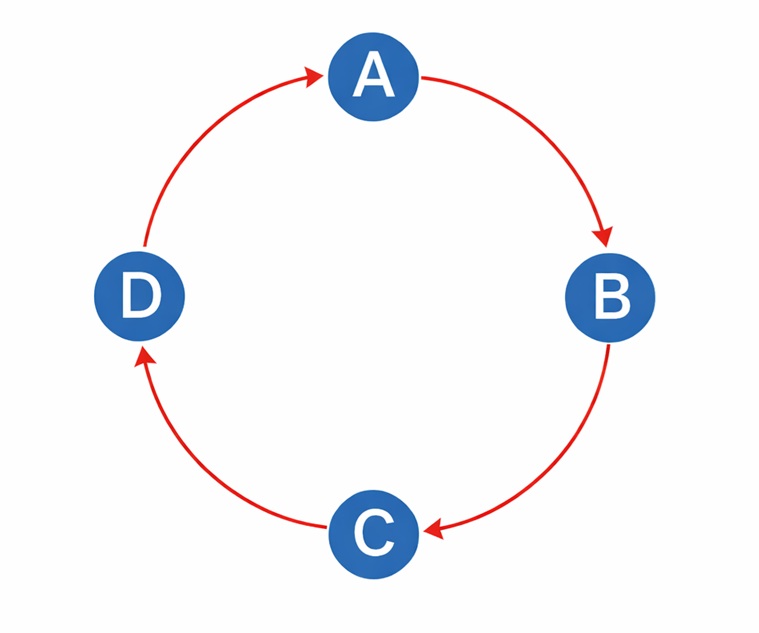
The Circular Referral Pattern for Suspending Responsibility[1] occurs when an individual, institution, or administrative authority, instead of dealing with a matter clearly and responsibly, refers the person concerned to another body, and, after several stages, this chain of referrals returns to its starting point without the substantive issue being genuinely examined or resolved.
In this pattern, responsibility is neither explicitly rejected nor explicitly accepted; rather, it remains suspended within a circular chain of referrals.
Explanation
In many administrative structures, the division of duties and areas of authority is natural. Not all issues fall within the remit of a single institution, and at times, referring the person concerned to the appropriate authority is a correct and necessary action. However, the problem arises when referral shifts from being a tool for responsible guidance into a tool for avoiding accountability.
In such cases, instead of receiving a clear answer, the person concerned is sent from one authority to another. Each authority states:
“This matter does not fall within my remit.”
Yet, none of them explains who is ultimately responsible for addressing the issue and what genuine path exists to resolve it.
Consequently, what appears on the surface to be merely an “administrative referral” becomes, in practice, a grinding cycle. This cycle causes the core issue to remain unanswered and responsibility to remain suspended.
This phenomenon is significant because it lies at the intersection of structural defects and moral weakness. Sometimes, the structure is genuinely ambiguous and flawed; yet, even under such conditions, the responsible person must treat the person concerned with honesty and a sense of responsibility, rather than sending them round in circles.
Common Structure of this Pattern
The common structure of this pattern is usually as follows:
- The citizen or person concerned has a real problem or a legitimate claim.
- They approach Authority A.
- A states that the matter falls within the remit of B.
- B states that the matter falls within the remit of C.
- C refers the person concerned to D.
- D refers them back to A.
- In the end, the issue remains unanswered, and responsibility is effectively suspended.
Examples from real life:
1. In an administrative complaint
An individual objects to an unfair decision made by an administrative body.
The first department states that this decision was made by another section.
The second section states that it was merely the executor and that the main decision-maker is elsewhere.
The next authority also refers the individual back to the first department.
As a result, the individual becomes lost among titles, signatures, and administrative units, while the substance of their complaint is not examined.
2. In municipal services
A citizen reports a problem in their neighbourhood, such as a disturbance, disorder, or a threat to public peace and comfort.
The municipality states that the police must handle the matter.
The police state that the matter must be pursued either by the municipality or by the judiciary.
The judiciary states that it will only intervene if it receives an official report from either the municipality or the police.
Ultimately, the citizen is faced with a closed loop.
3. In the education or welfare system
A parent notices that their child at preschool is not receiving enough food, comes home hungry, or shows signs that their basic needs are being neglected.
The parent first raises the matter with the preschool itself or with those responsible for it. The preschool may deny the problem, downplay it, or say that the matter falls within its internal programme, budget, or the managerial decisions of the owner and operator of the preschool.
When the parent complains to a supervisory body or educational authority, they may be told that dealing with this type of issue falls within the remit of another authority, or that it must be pursued through the municipality, the provider, or another supervisory body.
The municipality or local authority may also refer the matter to the limits of administrative supervision, the preschool’s internal decisions, or the absence of sufficient documentation. As a result, the core issue — namely, that the child has been left hungry and that their rights have been violated — is lost among the boundaries of authority, forms, administrative decisions, and referrals.
In such a situation, the parent is sent from one authority to another, but no official or institution clearly assumes responsibility for the practical defence of the child’s rights. Instead of resolving the issue, the administrative system buries the case of children’s rights violations in bureaucracy. The child remains a victim of the same situation, the family becomes exhausted, and the injustice continues.
Here, it should be noted that…
Each referral, in isolation, may appear superficially justified. In other words, every official or staff member may be able to say:
“I acted only within the limits of my own remit.”
However, what matters is not merely the apparent correctness of each individual link, but the practical consequence of the entire chain. If the final outcome of all these referrals is that the issue remains unanswered and the person concerned becomes tired and worn down, we can no longer say that we are dealing with a healthy and responsible process.
In the Circular Referral Pattern for Suspending Responsibility, not everything can be attributed to a flawed structure. Even if the division of authority is ambiguous, the responsible person can still act morally:
- They can honestly explain where the problem lies,
- they can clarify the correct path,
- and they can prevent the vicious circle from continuing.
So, if the person concerned is merely sent from one desk to another without anyone taking a step towards genuinely resolving the issue, we must ask:
Is only the structure at fault, or has morality also disappeared from the scene?
Why is this pattern dangerous?
1. Because it hides responsibility
In this pattern, no one explicitly says, “I am responsible for this,” or that the system is flawed. Responsibility is passed from one institution to another and, in practice, becomes lost.
2. Because it wears down the citizen
The person concerned is forced to spend their time, energy, and psychological strength on endless back-and-forth. In many cases, this very exhaustion causes the individual to give up pursuing their right.
3. Because it destroys public trust
When people repeatedly encounter such a cycle, they gradually feel that institutions were not created to solve problems, but to keep problems away from themselves.
4. Because it hides immorality behind administrative language
Official language, procedures, and the division of authority can become a cover for the absence of honesty and responsibility. In the long term, this process creates a culture of irresponsibility that is devoid of morality. In a culture of irresponsibility, immorality does not appear openly and violently; rather, it appears in official and administrative clothing.
5. Because it keeps the right suspended
In many injustices, the main problem is not that the right is explicitly denied, but that the right is placed in a state of suspension. On paper, the citizen has a right, but in practice they can neither enjoy it nor demand it.
The citizen’s moral and legal demand is not addressed, nor are they given any effective means to pursue their right.
How can we recognise it and respond to it?
First, we should pay attention to these signs:
- Have you returned to the starting point after several referrals?
- Has no authority entered into a substantive examination of the issue?
- Does everyone merely say, “This is not my duty”?
- Does no one explain who is ultimately responsible for providing an answer?
- Has the practical outcome of the entire process only been your exhaustion?
If the answer to these questions is yes, there is a strong possibility that you are facing the Circular Referral Pattern for Suspending Responsibility.
A suitable response might be:
- Ask each authority to provide its answer clearly and in writing.
- Do not simply accept the referral; ask: “Why are you referring me to this authority?”
- Ask: “If that authority does not deal with the matter either, who is ultimately responsible?”
- Record the chain of referrals: A to B, B to C, C to D, and D back to A.
Focus on the core issue — namely, your right — and avoid being drawn into movement between institutions.
Distinguish between structural error and moral evasion of responsibility, but do not allow either to become an excuse for ignoring the other. Sometimes, structural error and moral evasion of responsibility are intertwined, and both must be confronted.
Conclusion:
The Circular Referral Pattern for Suspending Responsibility occurs when a real issue, instead of being responsibly examined and resolved, is passed between institutions, and responsibility remains in a state of suspension.
This phenomenon is sometimes related to a structural defect, sometimes to moral weakness, and often to both.
However, what transforms this cycle into an exhausting, unjust, and dangerous situation is the absence of morality, which manifests in various forms, including a lack of honesty, moral courage, and a sense of responsibility.
Even if the administrative structure is genuinely flawed, the responsible person must treat the person concerned honestly, rather than sending them round in circles.
Wherever the person concerned is caught in a referral loop instead of receiving an answer, we must ask: Is only the structure flawed, or has morality also disappeared from the scene?
[1] This pattern is distinct from the logical fallacy of circular reasoning.
Circular reasoning is an error in reasoning in which the very conclusion that needs to be proved is itself used as part of the premise. However, the Circular Referral Pattern for Suspending Responsibility is an error in institutional and administrative action. In this pattern, an issue is referred from one authority to another and ultimately returns to the starting point without any substantive examination taking place. Therefore, in circular reasoning, thought becomes trapped in a circle of reasoning. By contrast, in the Circular Referral Pattern, responsibility is circulated within a closed administrative circle, and the individual’s right remains suspended.