
Explanation:
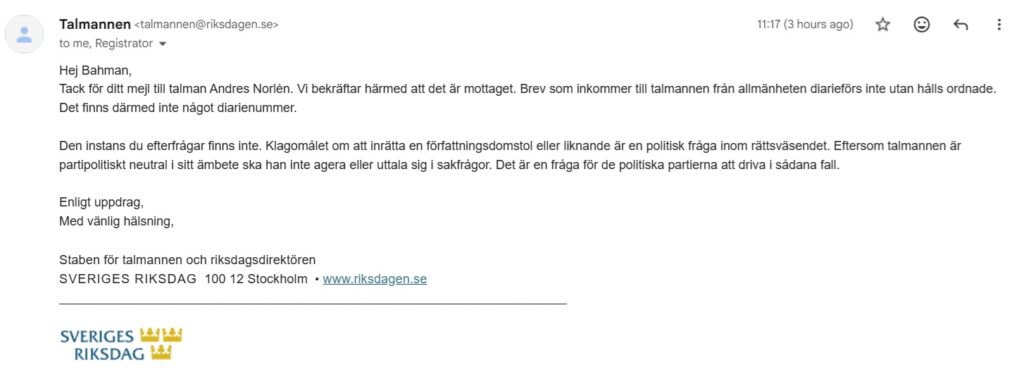
My formal request to the Speaker of the Riksdag was written in Swedish. The response from the Secretariat of the Speaker was received on 21 May 2026 and was also written in Swedish. For English-speaking readers, the response has been translated into English below. An image of the original Swedish response appears after the translation.
1. The Riksdag’s Response:
Dear Bahman,
Thank you for your email to the Speaker, Andreas Norlén. We hereby confirm that it has been received. Letters received by the Speaker from members of the public are not registered in the diary system, but are kept organised. Therefore, there is no diary number.
The authority you are asking for does not exist. The complaint concerning the establishment of a constitutional court or a similar body is a political matter within the justice system. Since the Speaker is party-politically neutral in his office, he must not act or express an opinion on substantive matters. In such cases, it is a matter for the political parties to pursue.
On behalf of the Speaker’s Office,
Kind regards,
The Secretariat of the Speaker and the Secretary-General of the Riksdag
THE SWEDISH PARLIAMENT
100 12 Stockholm
2. Analysis of Its Meaning:
When Responsible Officials Decline Responsibility
The response from the Secretariat of the Speaker of the Riksdag appears, on the surface, to be short, administrative and calm. However, if this brief response is read word for word, it reveals a more significant meaning: the citizen faces an institutional dead end in relation to the legislative structure itself.
The Secretariat first writes:
“Tack för ditt mejl till talman Andreas Norlén. Vi bekräftar härmed att det är mottaget.”
This means:
“Thank you for your email to the Speaker of the Riksdag, Andreas Norlén. We hereby confirm that it has been received.”
In other words, the letter has been received. Therefore, the question raised has not been ignored; it has been formally acknowledged and answered. The significance of the response begins here, because what follows is not silence, but a confirmation that inadvertently reveals a flaw in the existing structure.
The Secretariat then writes:
“Brev som inkommer till talmannen från allmänheten diarieförs inte utan hålls ordnade. Det finns därmed inte något diarienummer.”
This means:
“Letters received by the Speaker from members of the public are not registered in the diary system, but are kept organised. Therefore, there is no diary number.”
This means that letters from citizens to the Speaker of the Riksdag are not entered into the diary system and do not receive a diary number. From an administrative perspective, this may be an internal procedure. However, from the perspective of a citizen who has raised a fundamental question concerning the right of access to an independent authority, this part of the response is significant. A letter concerning the absence of an independent authority before which a complaint can be brought against the legislative structure itself is not even registered as a trackable case. In this way, before the core issue is addressed, the letter is treated as general correspondence rather than as a formal legal request capable of systematic follow-up.
The most significant sentence in the response is:
“Den instans du efterfrågar finns inte.”
This means:
“The authority you are asking for does not exist.”
This sentence contains the central meaning of the entire response. The central question of the letter was this: if a citizen believes that the Riksdag itself, or the legal and political structure connected to it, has violated their rights, to which independent judicial authority should that citizen turn? The Secretariat’s response does not indicate where such an authority can be found. The response states that such an authority does not exist.
Therefore, the Secretariat’s response does not resolve the issue; it describes it. The citizen asked about the absence of an independent path to judicial review, and the Secretariat effectively confirms that no such path exists.
The Secretariat further writes:
“Klagomålet om att inrätta en författningsdomstol eller liknande är en politisk fråga inom rättsväsendet.”
This means:
“The complaint concerning the establishment of a constitutional court or a similar body is a political question within the justice system.”
Here, a significant shift occurs. The citizen’s original question was not about which party should present a political programme for establishing a constitutional court. The question was this: in the existing situation, where should a citizen turn in order to bring an independent complaint against the Riksdag itself?
By turning this legal question into a “political question”, the Secretariat shifts the burden of responsibility from the sphere of the citizen’s right to independent judicial review to the sphere of party politics. Yet, if the issue is the citizen’s right of access to independent justice, referring the matter to political parties is not sufficient. Political parties are the forces that form the Riksdag. Therefore, a citizen who seeks to bring a complaint against the legislative structure itself is referred back to the same political arena that is itself the subject of the complaint.
Here, the Secretariat’s response bears the hallmarks of The Circular Referral Pattern for Suspending Responsibility. The citizen asks: if the problem lies with the legislature itself and the legislative structure, where is the independent authority that can examine the complaint? The response states that no such authority exists, and that the matter must be pursued through the same political forces that form the structure. In other words, in order to resolve a problem stemming from the legislative structure, the citizen is sent back to that very same political and legislative arena. In such a pattern, responsibility is neither openly accepted nor openly rejected, but remains suspended within a chain of referrals. This is not an independent path to judicial review; rather, it returns the question to its starting point.
The Secretariat then adds:
“Eftersom talmannen är partipolitiskt neutral i sitt ämbete ska han inte agera eller uttala sig i sakfrågor.”
This means:
“Since the Speaker is party-politically neutral in his office, he must not act or express an opinion on substantive matters.”
The principle of the Speaker’s party-political neutrality was not the subject of the request. The Speaker was not asked to take a political position or to choose a side in a political dispute. The question was this: where is the independent authority that can examine a complaint against the legislative structure itself?
Invoking party-political neutrality cannot serve as a substitute for institutional accountability. Party-political neutrality should not be interpreted as neutrality between justice and injustice. If a responsible official says that, because of party-political neutrality, he cannot speak about the absence of an independent path to judicial review, the rule of law, and the citizen’s right to demand justice, the result is that institutional responsibility is concealed behind neutrality, and the path to independent redress remains closed to the citizen.
Finally, the Secretariat writes:
“Det är en fråga för de politiska partierna att driva i sådana fall.”
This means:
“In such cases, it is a matter for the political parties to pursue.”
This means that, in such cases, it is a matter for the political parties to pursue. This sentence completes the deadlock. The citizen asks about the absence of an independent authority before which a complaint can be brought against the legislature, and the response states that no such authority exists and that the matter must be pursued by the political parties.
However, political parties are themselves part of that same legislative power structure. Therefore, the Secretariat’s response refers the citizen away from an independent authority and back to the same political structure that is itself the subject of the complaint.
The final meaning of the response is this: the Speaker does not intervene because of party-political neutrality; the Secretariat identifies no independent authority; the letter is not entered into the diary system; and the matter is deferred to the political parties. As a result, the relevant officials each decline responsibility, leaving the citizen without any independent path through which to demand justice.
From an administrative perspective, the response may be consistent with existing procedure. However, regarding the citizen’s right of access to independent judicial review, this response confirms a fundamental void. If there is no independent authority, such as a constitutional court or a similar body, to examine a complaint against the legislature itself, then the citizen’s right to demand justice against the legislature remains, in practice, without an effective instrument.
This response, rather than being a reasoned and logical defence of the existing structure, is the formal description of a deadlock. The Secretariat does not state where the citizen should turn; it states that the authority the citizen has requested does not exist. This sentence is the central meaning of the Riksdag’s response: the path through which the citizen can demand justice is closed.